In 2022, the U.S. spent a record $369 billion on climate change through the Inflation Reduction Act. This is the biggest investment in U.S. history for sustainable waste practices. It shows how important hazardous waste management and environmental compliance are for businesses. With new rules like the e-Manifest Final Third Rule starting on January 22, 2025, it’s key for EPA registered generators to keep up.
Hazardous waste management is more than just following compliance requirements. It’s about finding a balance between business needs and protecting the environment. Important areas include air quality, water management, land protection, and wildlife preservation. Companies can stay compliant and sustainable by using permits, monitoring, and ESG systems.
Good waste management helps save resources and cuts down on landfill use. It also helps companies meet ESG regulations. Not following these rules can cost a lot, disrupt operations, and worry investors. But, using eco-friendly waste solutions can improve environmental health and boost company reputations.
Key Takeaways:
- The e-Manifest Final Third Rule introduces mandatory registration and electronic submission requirements for EPA registered generators by 2025.
- Hazardous waste management involves balancing business needs with community and environmental requirements.
- Compliance mechanisms like permits, monitoring, and ESG systems ensure sustainable operations.
- Proper waste management practices contribute to resource conservation, reduced landfill usage, and corporate sustainability goals.
- Non-compliance risks financial penalties, operational disruptions, and investor apprehension, while eco-friendly practices enhance reputations.
Why Responsible Hazardous Waste Management Matters
Did you know that improper hazardous waste disposal costs businesses millions annually in fines and cleanup efforts? This statistic underscores the importance of responsible hazardous materials handling to avoid financial and environmental disasters.
Responsible hazardous waste management is crucial for both the environment and public health. In today’s industrial landscape, organizations generate various forms of chemical waste that, if not handled properly, can lead to severe consequences. Unmanaged hazardous waste can contaminate soil, water supplies, and air quality, posing risks not only to local ecosystems but also to community health. By prioritizing waste reporting protocols, companies can better track their waste streams and ensure they adhere to EPA waste regulations, ultimately fostering a safer environment for everyone.
One of the key aspects of responsible hazardous waste management is environmentally responsible disposal. This involves utilizing methods that minimize the negative impact on the environment while ensuring compliance with legal requirements. Techniques such as recycling, incineration, or secure landfilling of hazardous materials can mitigate toxic waste disposal risks. By promoting these practices, businesses not only protect the planet but also enhance their reputations, attracting eco-conscious consumers and investors who support sustainable practices.
Furthermore, integrating compliance-focused waste handling into waste management strategies is essential for ongoing improvement. These waste reporting protocols allow organizations to monitor their hazardous waste generation and disposal processes, identify trends, and pinpoint areas for reduction. Such accountability helps ensure that environmental standards are met and encourages companies to invest in innovative waste management solutions. Responsible hazardous waste management is not merely a regulatory obligation; it is a proactive approach that contributes to a sustainable future while safeguarding health and preserving natural resources.
By building a foundation of compliance and environmentally sound practices, companies not only meet regulations but also create long-term value. Responsible management enables them to adapt to future environmental challenges while maintaining the trust of stakeholders.
What Is the Cradle-to-Grave Concept?
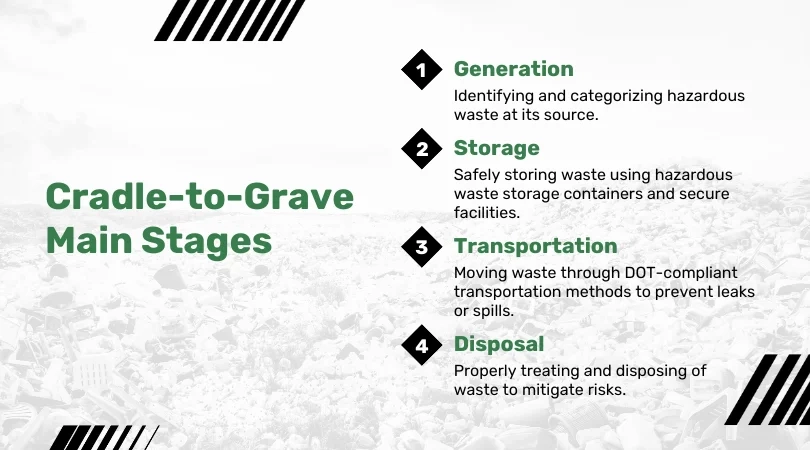
According to the EPA, over 40 million tons of hazardous waste are generated each year in the United States, making the cradle-to-grave concept essential for ensuring safe management throughout the entire hazardous waste lifecycle.
The cradle-to-grave concept is a key idea in managing RCRA waste. It means managing materials from start to finish. This includes four main stages:
- Generation: Identifying and categorizing hazardous waste at its source.
- Storage: Safely storing waste using hazardous waste storage containers and secure facilities.
- Transportation: Moving waste through DOT-compliant transportation methods to prevent leaks or spills.
- Disposal: Properly treating and disposing of waste to mitigate risks.
Following this concept helps reduce risks and protect the environment. It ensures safe waste management from start to end and creates a traceable system that improves accountability.
Key Terms in Hazardous Waste Management
| Term | Definition |
|---|---|
| Generator | The entity that produces hazardous waste |
| Transporter | The company responsible for waste transportation services from the generator to the disposal facility |
| Treatment, Storage, and Disposal Facility (TSDF) | A Part B permitted facility to handle, store, treat, and dispose of hazardous waste |
| Manifest | A document that tracks hazardous waste—sometimes called a hazardous waste manifest—from generation to disposal |
Knowing these terms and the cradle-to-grave concept helps businesses manage hazardous waste well. It ensures safety for the environment and public health. Businesses that integrate these principles demonstrate commitment to sustainability and compliance.
Understanding Hazardous Waste: Risks and Classifications
Each year, hazardous waste contributes significantly to global pollution levels, with industrial processes and improper disposal as primary culprits. Understanding these risks is crucial to mitigating environmental damage.
Hazardous waste is dangerous for people and the planet. It’s important to know what it is and how to handle it. The hazardous waste definition includes many things like liquids, solids, and sludges. These can come from making products or when materials can’t be used anymore. Understanding hazardous waste is essential for maintaining public health and safeguarding the environment.
Hazardous waste disposal encompasses a variety of materials, including liquids, solids, and sludges that require careful management due to their potential to harm human health or the ecosystem. Common sources include industrial processes, manufacturing, and even household products. To address these challenges, organizations must develop emergency waste procedures for spills and incidents involving hazardous materials. Training employees and investing in containment equipment can significantly reduce risks.
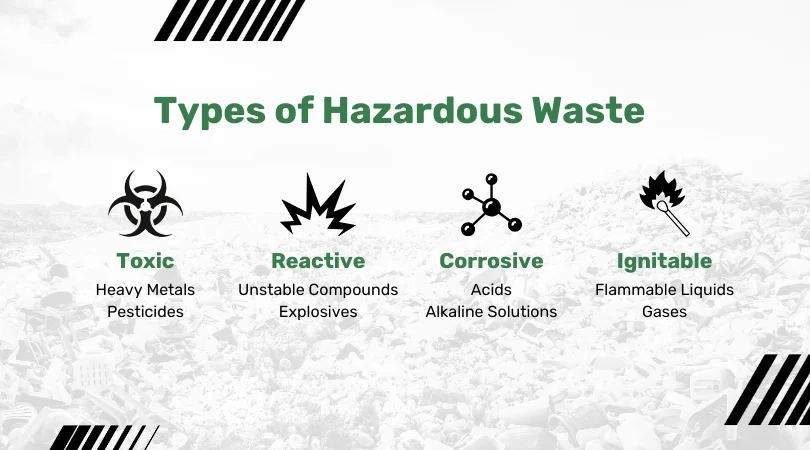
Types of Hazardous Waste
| Waste Type | Examples |
|---|---|
| Toxic waste | Heavy metals, pesticides |
| Reactive waste | Unstable compounds, explosives |
| Corrosive waste | Acids, alkaline solutions (corrosive waste disposal is crucial) |
| Ignitable waste | Flammable liquids, gases |
Generators are categorized by the amount of waste they produce:
Oregon and Idaho Generator Status Determination:
Very Small Quantity Generators (VSQG’s): Can generate up to 220 pounds of hazardous waste a month, but never more than 2200 pounds on site at one time. Can generate up to 2.2 pounds of Acute (P-Listed waste a month).
Small Quantity Generators (SQG’s): Can generate up to 2200 pounds of Hazardous Waste or 2.2 pounds of Acute (P-Listed) waste a month. Can generate waste for 180 days from the start date.
Large Quantity Generators (LQG’s): Generate more than 2200 pounds of hazardous waste or 2.2 pounds of acute waste in a month. Can generate waste for 90 days from the start date.
Washington State Generator Status Determination:
Small Quantity Generator (SQG/VSQG): Can generate up to 220 pounds of hazardous waste / Washington State Dangerous Waste a month or up to 2.2 pounds of Acute (P-Listed) / Extremely Hazardous Waste (EHW) a month.
Medium Quantity Generators (MQGs): Generate between 220 and 2200 pounds of Hazardous waste or Washington State Dangerous Waste a month or up to 2.2 pounds of Acute (P-Listed) / Extremely Hazardous Waste (EHW) a month. Can generate Hazardous Waste for up to 180 days from start date.
Large Quantity Generators (LQG’s): Generate more than 2200 pounds of Hazardous waste or Washington State Dangerous Waste a month or more than 2.2 pounds of Acute (P-Listed) / Extremely Hazardous Waste (EHW) a month. Can generate hazardous waste for up to 90 days from start date.
Each generator type has specific storage and disposal requirements, ranging from 90 to 270 days. Following these limits ensures proper management and prevents hazardous waste violations. Special waste categories like universal waste and household hazardous waste may have distinct rules. For instance, improper disposal of universal waste (e.g., old light bulbs) can harm ecosystems and endanger public health.
Detailed Comparison: Hazardous Waste Generators (VSQG, SQG, LQG)
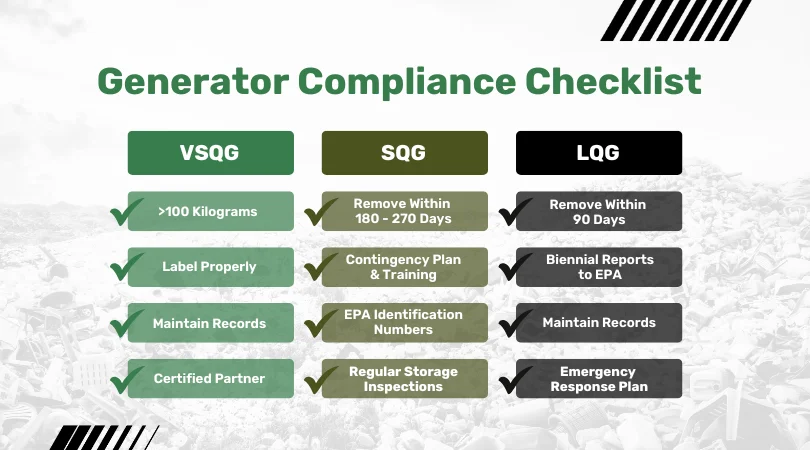
Understanding the differences between Very Small Quantity Generators (VSQG), Small Quantity Generators (SQG), and Large Quantity Generators (LQG) is critical for ensuring waste generators compliance and tailoring effective industrial waste disposal solutions. Each category has unique operational challenges and regulatory waste standards.
Very Small Quantity Generators (VSQG)
Operational Challenges:
- Produce less than 100 kilograms of hazardous waste per month, making storage and waste transportation services less frequent but still requiring strict adherence to regulations.
- Limited resources and expertise often make compliance audits more challenging.
Compliance Checklist for VSQG’s:
- Ensure hazardous waste is properly labeled and stored in approved containers.
- Do not exceed the maximum accumulation limit of 100 kilograms of hazardous waste.
- Maintain records of waste disposal services, including manifests and receipts.
- Partner with certified hazardous waste disposal services to ensure proper handling.
Cost-Effective Solutions:
- Utilize shared disposal services with nearby businesses to reduce transportation costs.
- Engage in waste reduction strategies like substituting hazardous materials with safer alternatives.
Small Quantity Generators (SQG)
Operational Challenges:
- Produce between 100 and 1,000 kilograms of hazardous waste per month, requiring regular waste pickups and adherence to more stringent storage requirements.
- Risk of hazardous waste violations increases with higher waste volume and stricter documentation requirements.
Compliance Checklist for SQGs:
- Ensure waste is removed within 180 days or 270 days if the disposal site is far.
- Implement a hazardous waste contingency plan and train employees on biohazard safety protocols.
- Secure EPA identification numbers for all waste activities.
- Conduct regular inspections of waste storage areas to identify and address risks.
Cost-Effective Solutions:
- Schedule regular pickups to avoid accumulation limits and ensure efficient operations.
- Invest in compliance training programs for employees to minimize errors and ensure smooth compliance audits.
Large Quantity Generators (LQG)
Operational Challenges:
- Produce over 1,000 kilograms of hazardous waste per month, requiring the most stringent compliance efforts.
- High volumes demand efficient storage, handling, and transportation processes to avoid fines and operational disruptions.
Compliance Checklist for LQGs:
- Submit biennial reports on hazardous waste activities to the EPA.
- Transport waste offsite within 90 days to comply with storage time limits.
- Maintain detailed records of waste shipments, manifests, and disposal certifications.
- Develop and implement comprehensive emergency response plans.
Cost-Effective Solutions:
- Partner with a full-service hazardous waste management provider like WasteXpress to streamline waste transportation services and disposal.
- Implement advanced waste tracking systems to optimize storage and transportation efficiency.
Tailoring Solutions to Generator Types:
By understanding the specific requirements and challenges of each generator category, businesses can develop customized onsite waste solutions that prioritize compliance and cost-efficiency. WasteXpress specializes in providing scalable services tailored to all types of generators, ensuring safe chemical disposal that meets both federal and state regulations.
Learn more about WasteXpress’ solutions for generators here.
Navigating Hazardous Waste Regulations and Compliance
A single violation of hazardous waste regulations can cost a business up to $70,000 in penalties. Navigating these rules effectively is essential for financial and operational stability.
The primary framework for hazardous waste management is the Resource Conservation and Recovery Act (RCRA), a crucial federal law designed to manage hazardous waste safely and efficiently. Businesses must:
- Conduct compliance audits to identify gaps in their waste management processes.
- Ensure staff are trained in DOT safety regulations and RCRA-compliant waste handling.
- Maintain accurate records, including hazardous waste manifest documentation, to track hazardous materials from generation to disposal.
State-specific regulations often add layers of complexity. Partnering with waste management experts like WasteX helps businesses ensure compliance at both federal and state levels, reducing risk and increasing operational efficiency.
Contact WasteXpress for compliance solutions.
In-Depth Guide to DOT and EPA Compliance
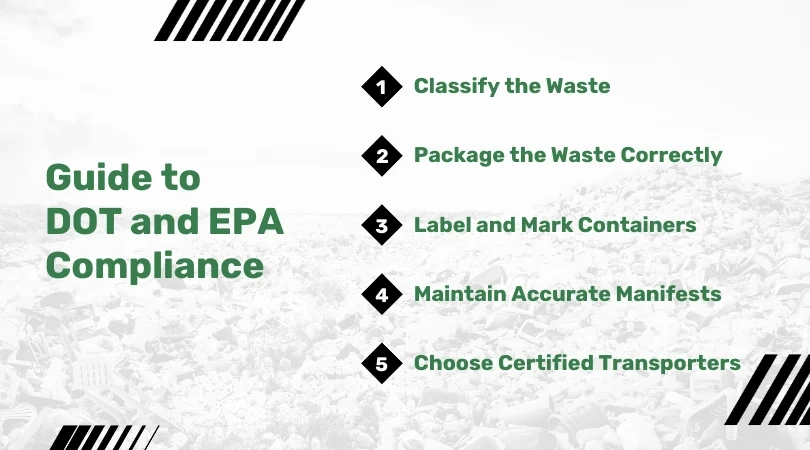
Navigating the complexities of DOT and EPA compliance is critical for businesses managing industrial-grade hazardous waste. Proper adherence to transportation safety standards and environmental regulations ensures safe waste shipping, prevents fines, and protects public health and the environment. Here’s a step-by-step guide to achieving compliance and avoiding common pitfalls.
Step-by-Step Instructions for DOT-Compliant Transportation
- Classify the Waste: Use the EPA’s hazardous waste classification system (ignitable, corrosive, toxic, reactive). Assign the correct waste code for labeling and documentation.
- Package the Waste Correctly: Use DOT-approved containers designed for the specific waste type (e.g., corrosion-resistant for acids, puncture-proof for sharps). Ensure secondary containment for bulk hazardous waste.
- Label and Mark Containers: Clearly label all containers with the appropriate hazard class and waste code. Include “HAZMAT” markings and placards on transport vehicles as required by DOT standards.
- Maintain Accurate Manifests: Complete a Uniform Hazardous Waste Manifest for every shipment. Ensure manifests include generator details, transporter information, and final disposal facility identification.
- Choose Certified Transporters: Partner with transporters who are certified in hazardous waste handling and meet all DOT requirements. Verify that vehicles are inspected and equipped for safe waste management.
Common DOT Violations and How to Avoid Them
- Improper Labeling: Ensure all containers are correctly labeled with hazard classes and waste codes.
- Non-Compliant Packaging: Use only approved containers designed for the hazardous waste type.
- Incomplete Manifests: Double-check all hazardous waste manifest forms for accuracy before transport.
- Inadequate Training: Provide comprehensive HAZMAT training to employees involved in packaging, labeling, or transportation.
Tips for Passing EPA Inspections and Audits
- Maintain Detailed Records: Keep up-to-date records of hazardous waste generation, transportation, and disposal activities. Ensure documentation is readily accessible for EPA review.
- Conduct Internal Audits: Regularly review compliance with EPA storage, labeling, and reporting requirements. Address any gaps before inspections.
- Ensure Proper Storage: Store hazardous waste in designated, well-maintained areas with proper secondary containment. Conduct weekly inspections of storage areas.
- Train Employees: Provide ongoing training on EPA hazardous waste regulations, reporting protocols, and emergency waste procedures. Ensure employees understand their roles during inspections.
- Partner with Professionals: Work with a trusted hazardous waste management provider like WasteXpress to streamline compliance and reduce risks.
Why Work with WasteX for DOT and EPA Compliance
Compliance with DOT and EPA regulations can be challenging, especially for large quantity generators managing complex waste streams. WasteX offers comprehensive services to:
- Ensure your hazardous waste is properly classified, packaged, labeled, and transported.
- Provide expert guidance on maintaining accurate records and passing EPA audits.
- Deliver compliance solutions to mitigate risks, avoid fines, and ensure safety.
By partnering with WasteXpress, you gain a team of professionals who simplify compliance and manage your hazardous waste efficiently and responsibly. Let us handle the complexities so you can focus on your core operations.
Contact WasteX today to learn more about our DOT and EPA compliance services.
Real-World Success: WasteXpress Projects and Case Studies
WasteXpress has a proven track record of solving complex hazardous waste challenges for various industries. Here are a few examples of how we’ve delivered exceptional results:
- Chemical Transportation and Reuse Project: WasteXpress safely transported and facilitated the reuse of hazardous chemicals for a chemical manufacturer. This project highlighted our expertise in compliance with DOT regulations while supporting sustainability-focused solutions.
- Lab Packing Services for School Districts: Partnering with a school district, WasteXpress provided lab packing services to package, label, and dispose of hazardous school waste materials from educational facilities. This ensured compliance and safety for staff and students.
- Episodic Waste Generation Solutions: WasteXpress offers flexible and efficient solutions for a building materials company managing a sudden increase in hazardous waste. Our scalable approach minimized disruptions and ensured compliance with EPA regulations.
- Drum Waste Disposal for Gas Stations: A chain of gas stations relied on WasteXpress to manage drum waste disposal across multiple locations. By offering tailored services, WasteXpress’ streamlined operations and eliminated regulatory risks.
These projects demonstrate WasteXpress’ ability to adapt to unique customer needs while ensuring environmental compliance and operational efficiency. Whether it’s lab packing, chemical transportation, or bulk hazardous waste management, WasteXpress delivers results you can trust.
Learn more about WasteXpress services.
Advanced Strategies for Waste Reduction
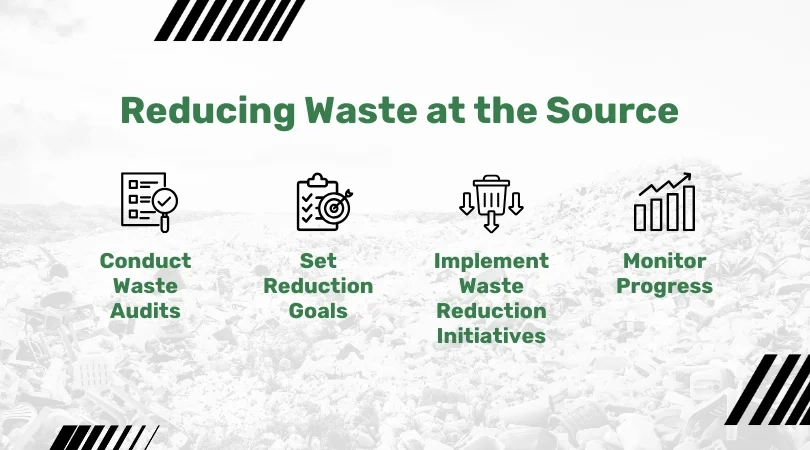
Reducing waste at its source is one of the most impactful ways businesses can contribute to environmental sustainability while lowering costs. By adopting waste reduction initiatives, companies can minimize environmental impact and align operations with federal waste guidelines and market demands.
Actionable Framework for Reducing Waste at the Source
- Conduct Waste Audits: Identify key waste streams and assess sources and volumes.
- Set Reduction Goals: Develop measurable targets based on audit findings and industry waste regulations.
- Implement Waste Reduction Initiatives: Utilize sustainability-focused solutions and train employees on eco-conscious practices.
- Monitor Progress: Use waste tracking systems to measure improvements and refine strategies.
Key Methods for Waste Reduction
- Process Optimization: Improve operational efficiency using real-time data analytics.
- Green Chemistry: Replace hazardous chemicals with safer alternatives to reduce toxic substance management issues.
- Closed-Loop Systems: Recycle materials back into production for landfill diversion strategies.
Environmental and Economic Benefits of Sustainable Practices
Sustainable hazardous waste disposal not only benefits the environment but also delivers measurable economic advantages to businesses. By adopting eco-conscious practices, companies can reduce operational costs, enhance reputation, and align with the principles of the circular economy.
Case Studies: Financial Gains from Sustainable Waste Management
- Energy Recovery and Fuel Blending Success: A manufacturer worked with WasteXpress to implement an energy recovery program, converting hazardous waste into usable fuel. This reduced disposal costs by 20% and saved an estimated $500,000 annually.
- Closed-Loop Recycling in Chemical Production: A chemical company partnered with WasteX to integrate a closed-loop recycling system for solvents. They cut raw material costs by 30% and eliminated over 200 tons of hazardous waste per year.
- Packaging Waste Reduction for Retailers: WasteXpress helped a major retailer redesign packaging materials to minimize waste and use recyclable components, reducing disposal expenses by 15%.
Statistics: Eco-Friendly Practices and Corporate Carbon Footprints
- Businesses investing in sustainable waste practices see an average 17% reduction in operating costs over five years.
- Companies implementing waste-to-energy solutions can cut greenhouse gas emissions by up to 50%.
- A 2023 survey shows 81% of consumers prefer to buy from environmentally responsible brands.
The Role of Circular Economy Principles in Hazardous Waste Management
- Recycling and Reuse: Hazardous materials, such as solvents or metals, can be reprocessed and reused, lowering hazardous waste disposal cost.
- Product Design for Sustainability: Redesign products to use fewer hazardous materials, reducing disposal complexity.
- Extended Product Life Cycles: Modular designs or repair-friendly features reduce the volume of waste generated.
- Collaboration Across Supply Chains: Partner with suppliers and customers to ensure waste is repurposed or recycled efficiently.
Partnering with WasteX for Success
Hazardous waste management is more than an obligation—it’s an opportunity to enhance environmental protection, ensure compliance, and build a better future. WasteXpress stands out by meeting and exceeding ODOT and DOT requirements for DOT-compliant transportation, ensuring your hazardous materials are managed safely and efficiently.
With a track record of successful compliance with federal waste guidelines, WasteXpress mitigates risks of fees, fines, or additional regulatory issues. Our team provides expert guidance, ensures proper documentation, and manages waste handling from start to finish, allowing businesses to focus on operations while WasteXpress takes care of the rest.
Call 855-224-3206 or fill out our online form to schedule a free consultation and explore tailored solutions for your hazardous waste management needs.
Frequently Asked Questions (FAQs)
1. What is hazardous waste, and why is proper management important?
Hazardous waste includes materials that are toxic, reactive, corrosive, or ignitable, posing risks to human health and the environment. Proper management ensures safety, prevents contamination, and complies with regulatory waste standards.
2. What are the key regulations governing hazardous waste management in the U.S.?
The Resource Conservation and Recovery Act (RCRA) is the primary law, along with TSCA waste management and DOT requirements, governing safe waste management and transportation.
3. What are the responsibilities of hazardous waste generators?
Generators must identify, label, store, and dispose of waste properly while maintaining accurate records and adhering to storage time limits based on their classification (VSQG, SQG, LQG).
4. How can businesses reduce hazardous waste generation?
Businesses can adopt waste reduction initiatives like process optimization, material substitution, and recycling. Partnering with providers like WasteXpress helps implement sustainable waste practices.
5. Why choose WasteXpress for hazardous waste management?
WasteXpress provides end-to-end compliance solutions, including transportation safety standards, and environmentally responsible disposal. Our expertise helps businesses meet EPA and DOT rules without unnecessary risks or costs.
People Also Asked
6. What are the 5 key steps for the proper handling of hazardous waste?
- Identify and classify hazardous waste.
- Store waste in compliant, labeled containers.
- Maintain accurate documentation and hazardous waste manifest records.
- Arrange for waste transportation services using DOT-compliant transportation.
- Ensure proper treatment and disposal at certified facilities.
7. What are the three R’s of sustainable waste management?
The three R’s are Reduce, Reuse, and Recycle—principles aimed at minimizing waste generation and promoting material recovery.
8. What are the 7 categories of hazardous waste?
- Ignitable
- Corrosive
- Reactive
- Toxic
- Universal waste
- Electronic waste
- Medical waste
9. What are the four questions the EPA uses to identify hazardous waste?
- Is the waste ignitable?
- Is the waste corrosive?
- Is the waste reactive?
- Is the waste toxic?
10. What are the 6 criteria pollutants monitored by the EPA?
- Carbon monoxide (CO)
- Lead (Pb)
- Nitrogen oxides (NOx)
- Ozone (O3)
- Particulate matter (PM10 and PM2.5)
- Sulfur dioxide (SO2)
11. What are the five criteria used to identify hazardous waste?
- Ignitability
- Corrosivity
- Reactivity
- Toxicity
- Listed waste (F, K, P, U categories)
12. How do you dispose of hazardous waste?
Hazardous waste must be transported and treated at certified disposal facilities under EPA and DOT regulations, ensuring safe chemical disposal.
13. How to dispose of hazardous waste in Oregon?
Partner with WasteXpress for compliance-driven solutions in Oregon. They offer lab packing services, waste-to-energy programs, and more—tailored to state-specific regulations.
14. How do you dispose of waste as regulated by OSHA?
Follow OSHA standards for employee safety during hazardous waste handling, including the use of PPE, correct labeling, and training on safe waste management procedures.